September 28, 2026
  admin
admin Industries that generate wastewater with chemicals, oils, suspended solids, organic matter, or other contaminants need a reliable treatment system before discharge or reuse. Choosing experienced effluent treatment plant manufacturers can make a significant difference in treatment performance, project execution, and long-term operating efficiency.
A turnkey Effluent Treatment Plant (ETP) provides industries with an integrated solution covering engineering, equipment manufacturing, installation, commissioning, and technical support. Instead of coordinating multiple contractors, industrial buyers can work with one project partner responsible for the complete treatment system.
An Effluent Treatment Plant is an industrial wastewater treatment system designed to reduce pollutants in effluent generated by manufacturing and processing operations.
Depending on the industry and wastewater characteristics, an ETP may be designed to control parameters such as:
The treatment process is selected according to the wastewater analysis, required treatment capacity, discharge or reuse requirements, available space, and applicable regulatory requirements.
For this reason, an ETP should not be treated as a one-size-fits-all system. Proper process selection and engineering are essential for achieving consistent treatment performance.
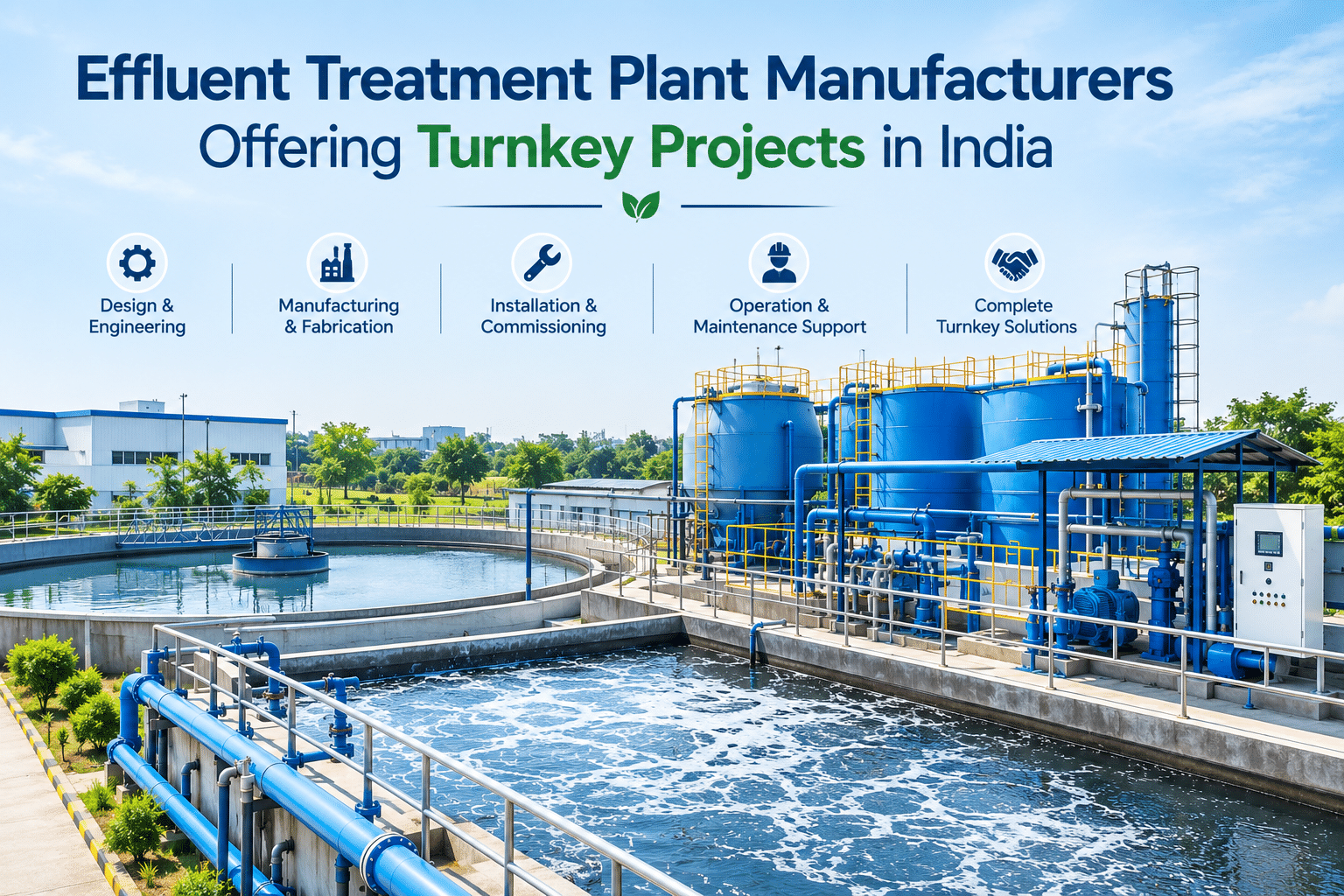
A turnkey ETP project means that one manufacturer or project partner takes responsibility for multiple stages of project execution. The exact scope can vary according to the project, but commonly includes the following.
The first step is understanding the wastewater generated by the industry. Important factors include flow rate, pH, BOD, COD, TSS, oil and grease, chemical characteristics, temperature, and other relevant parameters.
Based on these inputs, engineers can determine suitable treatment stages and equipment.
The treatment system is designed according to the required capacity and wastewater characteristics. Depending on the application, the process may include preliminary, primary, chemical, biological, tertiary, and sludge-treatment stages.
The objective is to create a treatment sequence that can achieve the required outlet quality while considering operating conditions and project constraints.
After finalizing the design, the required equipment and treatment components are manufactured or sourced according to project specifications.
This may include tanks, pumps, screens, chemical dosing systems, clarifiers, biological treatment systems, filtration equipment, sludge-handling equipment, and associated piping and controls.
A turnkey manufacturer can coordinate equipment installation, piping, electrical connections, instrumentation, and other system components.
Integrated project execution helps ensure that individual components work together as one treatment system.
Before handing over the plant, the system is checked and commissioned to verify equipment operation and process functionality.
Commissioning may include equipment testing, process checks, trial operation, and operator guidance, depending on the project scope.
After commissioning, technical support can help operators understand plant operation, routine maintenance, process monitoring, and troubleshooting requirements.
Ongoing support is particularly important for industrial ETPs because wastewater characteristics and production conditions can change over time.
Working with an experienced ETP plant manufacturer in India can simplify project execution and provide a single point of coordination.
A turnkey approach reduces the need for the customer to separately coordinate designers, equipment suppliers, installers, and commissioning teams.
Industrial wastewater varies considerably between sectors and even between individual manufacturing facilities. A customized ETP can be developed around actual wastewater characteristics rather than relying on a standard configuration.
When engineering, manufacturing, installation, and commissioning are coordinated by one project partner, communication between different stages can be more straightforward.
Industrial facilities often have limited space for wastewater treatment infrastructure. Proper engineering can help optimize equipment arrangement, accessibility, piping, and maintenance areas.
A coordinated turnkey project allows the manufacturer to understand the complete system and support commissioning across interconnected treatment stages.
ETPs are commonly required across industries that generate process wastewater. Applications can include:
Textile processing can generate wastewater containing colour, chemicals, suspended solids, and organic pollutants. Treatment requirements depend on the specific manufacturing process.
Pharmaceutical manufacturing may generate complex wastewater streams with varying chemical and organic characteristics. Treatment design needs to consider the specific effluent profile.
Chemical manufacturing can produce wastewater with changing pH, dissolved chemicals, suspended matter, and other contaminants. Proper characterization is important before selecting treatment processes.
Food-processing wastewater can contain significant organic loads, suspended solids, fats, oils, and grease. Biological treatment and suitable preliminary treatment may form important parts of the system.
Dairy wastewater can contain high organic content, fats, proteins, and suspended solids. Treatment systems are therefore designed around the characteristics and volume of the generated effluent.
Engineering, metal-processing, and other manufacturing operations may generate wastewater containing oils, suspended solids, chemicals, or other process-specific contaminants.
A technically suitable ETP starts with accurate project information. Before finalizing the design, manufacturers typically need to understand:
Laboratory testing and wastewater characterization can provide valuable information for selecting and sizing appropriate treatment stages.
This approach helps avoid selecting equipment based only on wastewater volume while overlooking the actual pollutant load.
Industrial buyers should evaluate more than the initial equipment price when selecting an Effluent Treatment Plant manufacturer.
Consider the manufacturer’s:
Engineering capability: Can the company develop a process based on the actual wastewater characteristics?
Manufacturing capability: Does the manufacturer have the capability to supply the required treatment equipment and components?
Project execution: Can the company coordinate installation, testing, and commissioning?
Customization: Can the system be adapted to capacity, wastewater characteristics, space, and project requirements?
Technical support: Is support available for commissioning, operation, troubleshooting, and maintenance?
Industry experience: Has the manufacturer worked with wastewater treatment requirements relevant to the customer’s industry?
A technically appropriate plant with proper project execution can be more valuable over its operating life than a system selected only on initial purchase cost.
Gopinath Enterprise provides industrial pollution-control and wastewater treatment solutions for businesses seeking engineered treatment systems.
As an Effluent Treatment Plant Manufacturer in India, Gopinath Enterprise can support projects based on wastewater characteristics, treatment capacity, site conditions, and application requirements.
The project approach can cover key stages such as system planning, equipment selection, manufacturing, installation, commissioning, and technical support.
For industries evaluating a new ETP or upgrading an existing wastewater treatment system, a properly engineered solution can help create a more reliable and manageable treatment process.
A turnkey ETP project is an integrated wastewater treatment project in which one project partner manages major stages such as engineering, equipment supply or manufacturing, installation, commissioning, and technical support.
Evaluate the manufacturer’s engineering expertise, relevant industry experience, manufacturing capabilities, customization options, project execution experience, commissioning support, and after-sales technical service.
No. ETP design depends on wastewater characteristics, flow rate, pollutant load, required outlet quality, available space, process requirements, and other project-specific factors.
Industries including textile, pharmaceutical, chemical, food processing, dairy, manufacturing, and other sectors that generate industrial wastewater may require an ETP depending on their wastewater characteristics and applicable requirements.
Yes. Existing plants can potentially be modified or upgraded depending on their current design, treatment performance, available space, wastewater characteristics, and required capacity. A technical assessment should be carried out before selecting an upgrade strategy.
Selecting the right effluent treatment plant manufacturers is an important decision for industries planning a new wastewater treatment facility or upgrading an existing system. A turnkey approach can simplify project coordination by bringing engineering, manufacturing, installation, commissioning, and technical support together.
The most suitable ETP should be based on actual wastewater characteristics and project requirements rather than a generic design. With proper engineering and project execution, industries can establish a treatment system designed for their operational needs.
If your industry is planning a new ETP or turnkey wastewater treatment project, Gopinath Enterprise can help evaluate your requirements and develop a suitable industrial wastewater treatment solution.